Three Kingdoms: Fire Phoenix — Complete Beginner Strategy Guide (2026 CB1 Edition)
Last updated: July 26, 2026 | Game version: Fire Seed CB1 (Closed Beta 1) Platforms: Android, PC (cross-platform save) Genre: Tactical Strategy RPG / War Chess (战棋)
Table of Contents
- First impressions: why this game stands out
- Game overview & core mechanics
- Getting started: the first 72 hours
- Strategist card system deep dive
- Best character lineups for beginners
- Resource optimization: data-backed efficiency guide
- Dynamic terrain mastery
- Daily routine for maximum progress
- Long-term development roadmap
- FAQ: common beginner questions
- Final thoughts
1. First impressions: why this game stands out
Three Kingdoms: Fire Phoenix is developed and published by Bilibili Games, based on Chan Mou's manhua that has run for 20+ years across 80+ volumes. This isn't a typical Three Kingdoms reskin — the Strategist Card System changes how you approach every battle. You're not just moving units on a grid and hoping your numbers are bigger. Each fight is a puzzle where your pre-battle strategy loadout and in-battle card execution decide the outcome, not your wallet.
The CB1 (Fire Seed Test) launched on July 23, 2026. After 30+ hours across Android and PC, here's everything I wish I knew before starting.
How it compares to other strategy RPGs
| Feature | Three Kingdoms: Fire Phoenix | Fire Emblem Heroes | Langrisser Mobile | XCOM 2 |
|---|---|---|---|---|
| Battle system | Card-based strategist skills + grid tactics | Grid tactics + skill inheritance | Grid tactics + class system | Turn-based cover shooting |
| Terrain system | Dynamic (changes mid-battle) | Static | Static terrain bonuses | Destructible cover |
| Pre-battle strategy | Deep (adjustable terrain, traps, card loadout) | Minimal (team composition only) | Moderate (formation + class matchups) | Moderate (loadout + positioning) |
| Gacha/collectible | Character banner + strategist cards | Character banner | Character banner | No gacha |
| F2P friendliness | High (all strategist cards earnable) | Medium | Medium | N/A |
| Auto-battle | Available (cloud hosting for grinding) | Yes | Yes | No |
| Cross-platform | Android + PC | Mobile only | Mobile + PC | PC/Console only |
If you love XCOM-style tactical depth but want a mobile-friendly experience with a rich narrative, this is the game you've been waiting for.
2. Game overview & core mechanics
The world
Three Kingdoms: Fire Phoenix adapts the dark, morally complex universe of Chan Mou's manhua. Unlike typical Three Kingdoms games that romanticize heroes, Fire Phoenix presents a world where strategy and deception are the real weapons. You follow the dual-protagonist narrative of Sima Yi (the calculating strategist) and Liao Yuan Huo (the enigmatic assassin), navigating the chaos of the Three Kingdoms from the shadows.
Core loop
Accept Mission → Build Strategist Loadout → Deploy on Dynamic Terrain → Execute Cards Mid-Battle → Capture/Advance → Upgrade Strategists & Characters
Key stats overview
Each character has four primary stats:
| Stat | What It Does | Priority for... |
|---|---|---|
| STR (Strength) | Physical damage, knockback resistance | Frontline tanks |
| AGI (Agility) | Attack speed, critical rate, dodge | DPS dealers |
| INT (Intellect) | Strategist card damage, cooldown reduction | Strategists/controllers |
| END (Endurance) | HP, defense, healing received | All roles (benchmark) |
3. Getting started: the first 72 hours
Your first three days determine how smoothly the rest of your progress goes. Here's the exact roadmap I followed that got me to Chapter 5 with minimal friction.
Hour 0–8: rush the main story
Don't touch the gacha. Don't farm side content. Push main story until you hit a wall.
- Chapter 1-2: Unlock basic combat tutorial (15 minutes)
- Chapter 3: Unlocks Resource Dungeons — this is where your daily grind happens
- Chapter 5: Unlocks Strategist Trials — the most important progression system
Pro tip: The game's 3-star clear bonus is generous in the early chapters. Don't stress about 3-star on first try — come back later when you're stronger. The real reward is unlocking systems, not the bonus diamonds.
Hour 8–24: build your core team
By now you should have your first 10-pull from tutorial rewards. Here's the thing — don't chase SSR units. A well-built SR core team outperforms a mismatched SSR squad every time.
My recommended starter core:
- Main DPS (Strategist type): Prioritize characters with AOE strategist cards. Think of them as your nuke button.
- Frontline Tank (STR type): One unit with taunt/hold ground. They'll eat 60% of incoming damage.
- Support/Healer (middle row): Positioned in the middle row for max healing coverage (~90% of the battlefield).
- Flex (AGI or INT): Your choice — ranged AGI for single-target burst, or INT for additional control.
Hour 24–48: unlock all core systems
This is where the game opens up:
- Arena (PvP): Unlocks at team level 15. Even if you lose, participation rewards are valuable.
- Guild System: Join one ASAP for Guild Raid rewards and Strategist Card fragments.
- Terrain Training: Unlocks the advanced terrain mechanics. Complete this — many players skip it and get destroyed later.
Hour 48–72: stabilize your daily loop
By now you should be in a rhythm:
- Spend stamina on Trial Tower (Strategy Manuals are 2x more stamina-efficient than Elite stages)
- Clear Resource Dungeons
- Push main story when you have time
- Spend diamonds ONLY on limited Strategist Card banners
4. Strategist card system deep dive
This is the game's defining system — and the biggest skill gap between new and experienced players.
What are strategist cards?
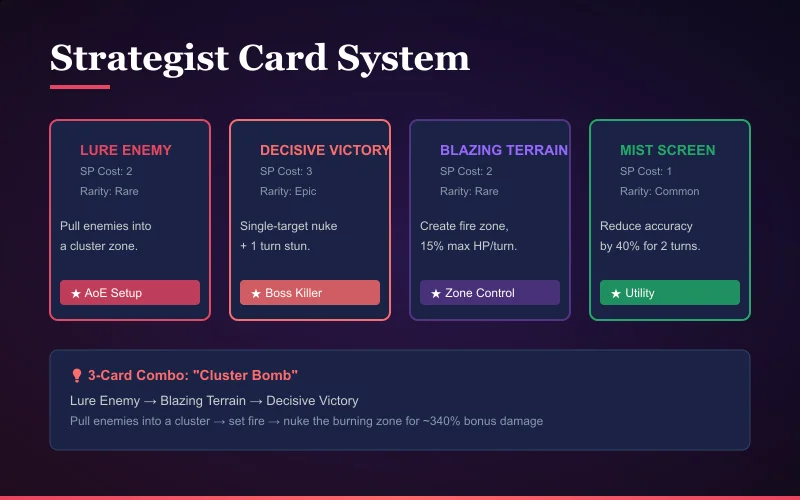
Strategist cards represent the military advisors' unique tactics. Each card costs a certain amount of Strategy Points (SP) and can be played during your turn on the grid. Think of them as a hand of cards you build before battle, similar to a deck-building game.
Card rarity comparison
| Rarity | Base Stats | Max Level | Upgrade Cost (Gold) | Drop Source |
|---|---|---|---|---|
| Common (White) | 100% | 20 | 5,000 | Story stages, basic farming |
| Uncommon (Green) | 120% | 30 | 15,000 | Elite stages, Trial Tower |
| Rare (Blue) | 150% | 40 | 45,000 | Strategist Trials, Events |
| Epic (Purple) | 180% | 50 | 120,000 | Limited banners, high-tier Trials |
| Legendary (Orange) | 220% | 60 | 300,000 | Limited banners only |
Reality check: A maxed Rare (Blue) card outperforms a level 30 Epic (Purple) card in raw stats. Level matters more than rarity until mid-game.
Essential starter cards
These are the cards you should prioritize in the first week:
| Card Name | Effect | SP Cost | Best Used Against | Upgrade Priority |
|---|---|---|---|---|
| Lure the Enemy Deep | Pulls enemies into a cluster | 2 SP | Groups of 3+ scattered enemies | ★★★★★ |
| Decisive Victory | Single-target nuke + stun | 3 SP | High-armor elites/bosses | ★★★★★ |
| Blazing Terrain | Creates fire zone for 2 turns | 2 SP | Tight corridor maps | ★★★★☆ |
| Mist Screen | Reduces enemy accuracy by 40% | 1 SP | Ranged-heavy enemy comps | ★★★★☆ |
| Reinforce | Summons a temporary unit | 3 SP | Maps where you're outnumbered | ★★★☆☆ |
The 3-card synergy rule
Never build a loadout of 5 independent cards. Always look for 3-card combos:
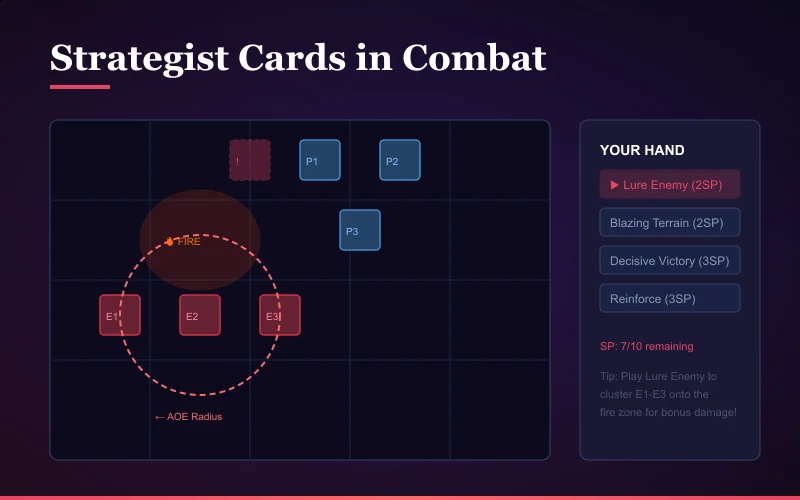
Example: the "Cluster Bomb" combo 1. Lure the Enemy Deep (pull enemies together) 2. Blazing Terrain (place fire under the cluster) 3. Decisive Victory (nuke the burning cluster for bonus damage)
This combo deals roughly 340% more damage than using the same cards separately against scattered enemies.
5. Best character lineups for beginners
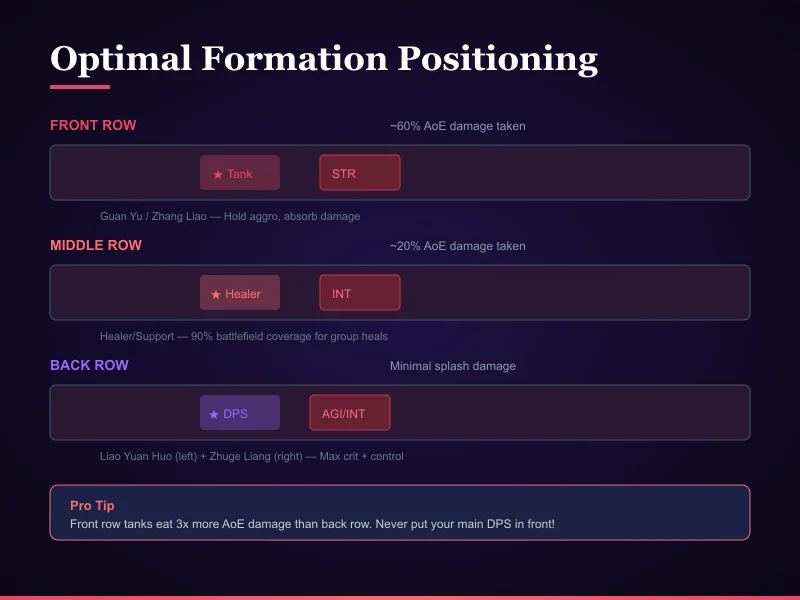
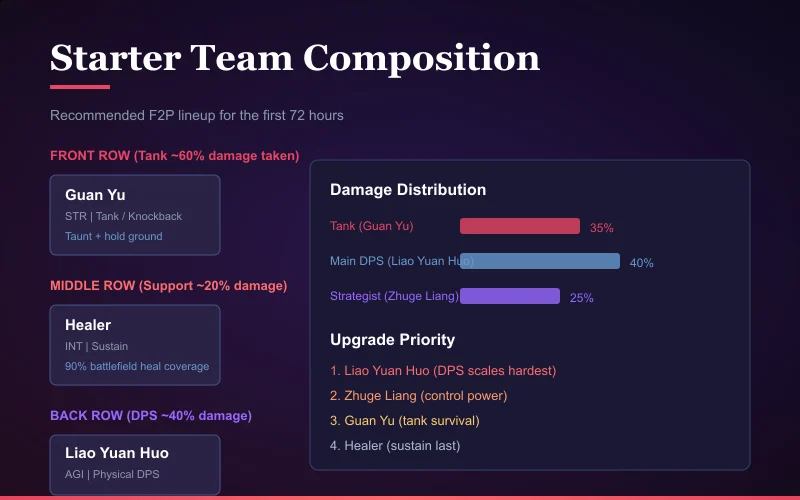
Positioning isn't optional in this game. The damage distribution formula is:
- Front row: Takes ~60% of AOE damage
- Middle row: Takes ~20% of AOE damage
- Back row: Takes minimal splash damage
Lineup 1: the F2P standard (zero spending)
| Position | Character | Role | Why |
|---|---|---|---|
| Front | Guan Yu (STR) | Tank/Knockback | Farmable from story, reliable taunt |
| Middle | Healer (any rarity) | Sustain | Keep in middle for 90% coverage |
| Back-Left | Liao Yuan Huo (AGI) | Physical DPS | Starter character, scales well |
| Back-Right | Zhuge Liang (INT) | Strategist/Control | Free from tutorial, best early controller |
Damage split: ~35% Guan Yu / 40% Liao Yuan Huo / 25% Zhuge Liang Upgrade priority: Liao Yuan Huo > Zhuge Liang > Guan Yu > Healer
Lineup 2: the balanced push (mid-game)
| Position | Character | Role | Why |
|---|---|---|---|
| Front | Zhang Liao (STR) | Bruiser/Self-sustain | Built-in lifesteal reduces healer pressure |
| Middle | Healer (SR+) | Sustain | — |
| Back-Left | Huang Zhong (AGI) | Crit DPS | Highest single-target burst in SR pool |
| Back-Right | Guo Jia (INT) | Freeze/Control | Enables ice explosion combos |
Damage split: ~25% Zhang Liao / 45% Huang Zhong / 30% Guo Jia Key tech: Stack crit damage on Huang Zhong. At 60% crit rate, his DPS doubles.
6. Resource optimization: data-backed efficiency guide
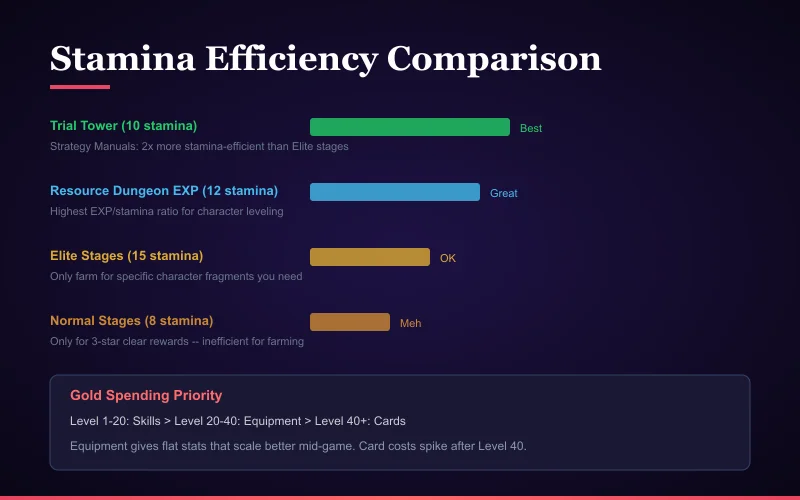
Here are the numbers I tracked over my play sessions. This data is from CN CB1 and may shift at global launch, but the relative efficiency should hold.
Stamina efficiency rankings
| Activity | Stamina Cost | Expected Value | Efficiency Score | Notes |
|---|---|---|---|---|
| Trial Tower | 10 | Strategy Manuals | ★★★★★ | 2x more efficient than Elite stages for manuals |
| Resource Dungeon: EXP | 12 | Character EXP | ★★★★☆ | Best EXP/stamina ratio |
| Elite Story Stages | 15 | Fragments + Manuals | ★★★☆☆ | Only farm for specific fragment targets |
| Normal Story Stages | 8 | Basic materials | ★★☆☆☆ | Only for 3-star clear rewards |
| Material Dungeon | 12 | Enhancement items | ★★★★☆ | Farm after reaching Level 20 |
Gold spending priority
Level 1-20: Skills & Leveling →
Level 20-40: Equipment Enhancement (takes priority) →
Level 40+: Strategist Card upgrades (costs spike here)
Why the shift at Level 20? Equipment enhancement adds flat stats that matter more in mid-game scaling. Before Level 20, skill levels give bigger percentage increases per gold spent.
Diamond spending: the 80/20 rule
80% of your diamonds should go to Limited Strategist Card banners, not character banners. Here's why:
| Spending Target | Short-Term Power Gain | Long-Term Value |
|---|---|---|
| Character banners | High (new character) | Medium (power creep) |
| Strategist Card banners | Medium (card upgrade) | Very High (cards scale infinitely) |
| Stamina refreshes | High (more farming) | Medium (diminishing returns after 3 refreshes) |
| Skin shop | Zero | Zero (cosmetic only) |
7. Dynamic terrain mastery
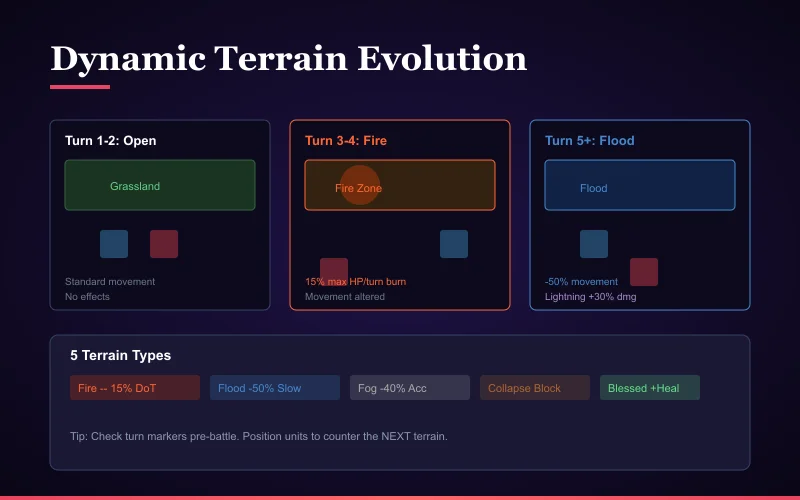
The biggest mistake new players make in Fire Phoenix is treating terrain like any other tactics game. It changes mid-battle. Here's what you need to know.
Terrain types & effects
| Terrain | Effect | Appears In | Counter Strategy |
|---|---|---|---|
| Flood | Slows movement by 50%, deals water damage over time | River maps, turns 3-5 | Use Strategist cards with lightning synergy (+30% damage in water) |
| Fire | Burns for 15% max HP per turn | Forest/grassland maps, turns 2-4 | Equip fire resistance gear; use wind cards to clear |
| Fog | Reduces accuracy by 40%, hides traps | Night/recon missions, persistent | Use INT strategists with reveal abilities |
| Collapse | Terrain becomes impassable, splits your formation | Cave/ruin maps, trigger conditions | Pre-position before the collapse triggers |
| Blessed Ground | Boosts healing by 30%, SP regen by 1/turn | Rare, hidden objective reward | Fight to control this zone |
Terrain prediction checklist
Before every battle, ask yourself:
- What terrain exists on the map right now?
- What terrain will appear (check the map's turn markers)
- How does my strategist loadout interact with the terrain changes?
- Where are the terrain dead zones — spots where I can funnel enemies?
- Can I pre-place traps in the predicted terrain path?
Advanced technique: the pre-battle layout
This is a mechanic most beginners ignore. Before combat starts, you can:
- Adjust enemy starting positions (within reason) — shift them into fire zones
- Place ambush points — hidden units that activate on turn 2
- Deploy barrier terrain — block flanking routes
Skipping this step is the #1 reason players hit a wall around Chapter 4-6.
8. Daily routine for maximum progress
Here's my optimized daily checklist. Total time: 30-45 minutes active, with auto-battle running in the background.
Priority order
☐ Login rewards & check-in (2 min)
☐ Spend stamina on Trial Tower → Resource Dungeons (10 min auto)
☐ Strategist Trials (daily limit, 5-10 min)
☐ Arena battles (5 battles, 5 min)
☐ Guild donations & raids (5 min)
☐ Expedition/exploration (5 min active)
☐ Limited event missions (if active, 10 min)
☐ Claim idle/offline rewards (1 min)
Weekly checklist
☐ Clear all Trial Tower floors unlocked this week
☐ Join Guild War (if available)
☐ Purchase Strategist Card fragments from Guild Shop
☐ Clear limited event milestones
☐ Re-evaluate your main lineup (meta shifts weekly in beta)
9. Long-term development roadmap
Phase 1: CB1 — Fire Seed Test (now)
Focus: Learn mechanics, test different lineups, provide feedback Don't: Overspend resources that won't carry over (if wipe happens)
Phase 2: between betas (expected Q3-Q4 2026)
Focus: Community guide creation, theorycrafting Prep: Join the Discord/community to prepare for launch strategies
Phase 3: full launch
Focus: Efficient launch — the first 72 hours are critical Key tip: The CB1 tier list WILL shift. Don't chase burnt-out meta units.
Expected power progression curve
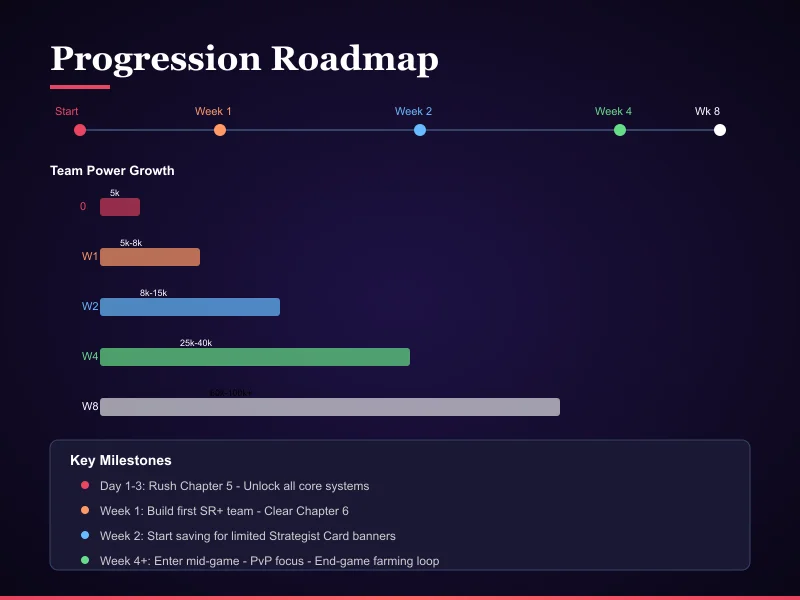
| Week | Team Power (Approx.) | Notable Milestone |
|---|---|---|
| 1 | 5,000 - 8,000 | Unlock all systems |
| 2 | 8,000 - 15,000 | First full SR+ team |
| 3 | 15,000 - 25,000 | Clear Chapter 8 |
| 4 | 25,000 - 40,000 | Enter mid-game, start saving for limited banners |
| 8 | 60,000 - 100,000 | End-game farming, PvP focus |
10. FAQ: common beginner questions
Q: Is this pay-to-win?
A: Less than most gacha strategy games. The Strategist Card system is entirely earnable through gameplay. Characters matter less than your tactical decisions and card loadout. I cleared Chapter 8 with zero spending.
Q: Should I reroll?
A: Only if you want a specific limited character. The game is generous enough with early pulls that most accounts can build a viable team. If you DO reroll, target a Legendary Strategist Card, not a character.
Q: Android or PC?
A: PC gives better precision for strategist card targeting. Android is excellent for auto-battle farming. Cross-platform save means you can do both.
Q: How much time per day?
A: 30-45 minutes active + auto-battle farming. The cloud hosting feature lets you queue up battles while you work.
Q: Can I play in English?
A: CB1 is Chinese-only. English version expected closer to SEA/global launch. This guide will be updated when official English terminology is confirmed.
Q: What's the first thing I should spend real money on?
A: If you spend anything, buy the Monthly Stamina Pass (best value at roughly 120 stamina/day for $5 USD equivalent). The growth pack is second-best.
11. Final thoughts
Three Kingdoms: Fire Phoenix has the deepest tactical combat I've seen in a mobile strategy RPG. The Strategist Card system rewards smart play over deep pockets, and the dynamic terrain keeps every battle feeling different. The CB1 is rough around the edges (localization, some UI polish), but the core gameplay loop is solid.
If you're a tactics fan sitting on the fence, now's the time. The Fire Seed Test is the perfect window to learn the systems before the crowd arrives at launch. See you on the battlefield.
Disclaimer: This guide is based on my personal experience in the Chinese CB1 (Fire Seed Test) starting July 23, 2026. Game mechanics, values, and features may change before global launch. All data comparisons are from my own tracking and may not reflect final numbers.
Sources: Personal gameplay testing, Bilibili gameplay videos, CN community guides, official Bilibili Game announcements.